Picture the dream: at 65, you pack two suitcases, lease a sunlit villa along the Algarve coast in Portugal or a hillside condo in Costa Rica, and bid farewell to American healthcare bills. Local comprehensive private insurance costs you barely $120 a month, and routine doctor visits run $40 out of pocket.

The Overseas Dream
Affordable local private healthcare makes paying U.S. premiums feel unnecessary.
The Cumulative Cost Reality
Delaying enrollment steepens your future slope through permanent lifetime surcharges.
Then comes the letter from the Social Security Administration regarding Medicare Part B (outpatient medical insurance) and Part D (prescription drug coverage). Medicare pays zero dollars outside the 50 United States and U.S. territories. Why would any rational expat pay hundreds of dollars every month for insurance they literally cannot use?
So you decline Part B and skip Part D to pocket the immediate cash savings. It feels like an effortless financial win. But Medicare’s architecture is quietly asymmetric: the moment you drop coverage without qualifying employer health insurance, a compounding penalty clock starts ticking—and it never stops.
The Five Layers: How the Expat Medicare Trap Actually Works
1. What is it?
Medicare Part A covers inpatient hospital stays (premium-free for most people with 40 work quarters), but Part B (doctors and outpatient care) and Part D (prescriptions) require monthly premiums. If you don't enroll when you first turn 65 and lack "creditable coverage" through an active group health plan, you face a permanent Late Enrollment Penalty (LEP) if you ever sign up later.
2. How does the mechanism work?
The penalties compound based on how long you were eligible but uncovered:
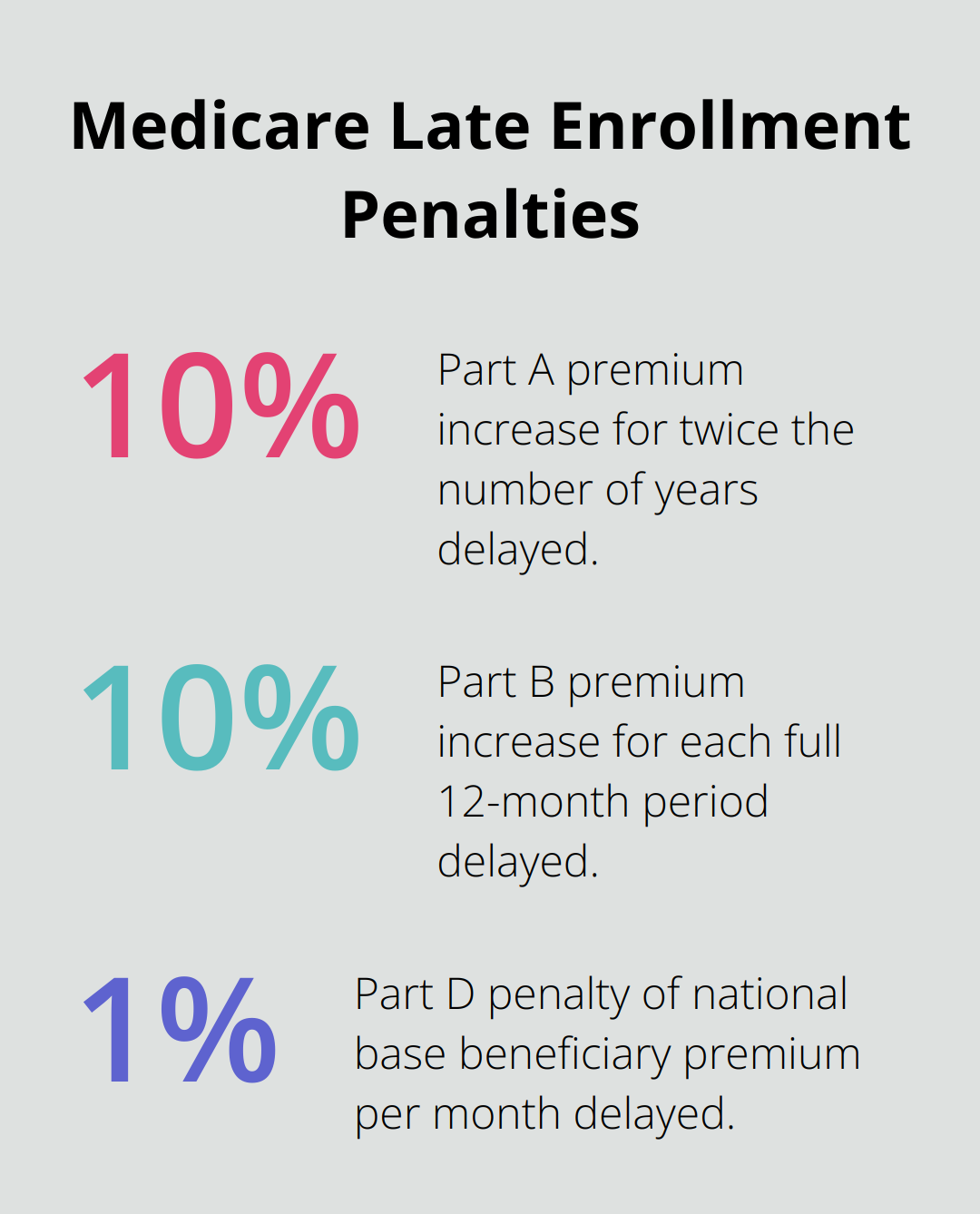
- Part B Penalty: A strict 10% surcharge for every full 12-month period you delayed enrollment. If you wait 10 years (from age 65 to 75), your Part B premium is slapped with a lifetime +100% surcharge. You will pay exactly double the standard monthly premium for the rest of your life.
- Part D Penalty: A 1% surcharge per uncovered month (12% per year) calculated against the national base beneficiary premium. Ten years without Part D means a +120% permanent penalty on top of your plan's drug premium.
3. Why does this system exist?
To combat adverse selection. If healthy 65-year-olds could opt out of paying premiums during their healthiest retirement years and jump back into the risk pool only at 78 when they develop chronic illness, the entire Medicare insurance pool would collapse financially. The penalty was engineered to make skipping coverage punitive.
4. Who benefits?
The federal insurance pool captures reliable monthly revenue from retirees worldwide. Foreign private insurers also benefit by selling affordable local care. But the expat who plans to return home late in life bears the entire asymmetric downside.
5. Why should you care?
Almost nobody anticipates moving back to the U.S. when they move abroad at 65. But cognitive decline, the death of a spouse, political shifts, or specialized medical diagnoses (like oncology or complex neurosurgery) often compel retirees to return to family in their late 70s or 80s. When you arrive, private individual health insurance is no longer an option—Medicare is the only gatekeeper.
Does comprehensive foreign national health insurance (e.g., in Portugal, Spain, or Costa Rica) count as "creditable coverage" to waive Medicare late penalties?
Tap to verify your understanding →
The Mathematical Dilemma: Phantom Premium vs. Lifetime Surcharge
Let's run the balance sheet. Suppose the standard Part B + D baseline cost is approximately $225/month (~$2,700/year).
If you live overseas from age 65 to 75 without paying Medicare, you keep $27,000 in your pocket over that decade.
However, if you move back to the U.S. at age 75, your Part B penalty is +100% and Part D is +120%. Your monthly premium jumps from $225 to roughly $459—an extra $234 per month in pure penalties (~$2,808/year). To erase your initial $27,000 savings, you would need to live another 9.6 years in the U.S. (until age 84.6).
The penalty isn't just money—it's time without care.
Most people focus entirely on the dollar penalty. But the true operational trap is the General Enrollment Period (GEP). If you return to the U.S. in April with a medical crisis, you cannot just sign up immediately. You must wait until the next GEP (January 1 – March 31).
During those months of waiting, you have zero coverage in the United States. One unexpected hospitalization or cardiac event during that uninsured window can wipe out 15 years of premium savings in 72 hours.
How to Think About the Decision Framework
Deciding whether to pay Part B and D while living abroad comes down to three realistic scenarios:
- The Permanent Expat (Probability of return < 10%): If you hold dual citizenship, own permanent property abroad, have deep local community ties, and have committed to end-of-life care in your host country, paying thousands of dollars for a ghost policy makes little economic sense. Pocket the savings.
- The Snowbird / Hedger (Probability of return 25% – 50%): If your children live in the U.S. or you maintain a home base state-side, treat the baseline Medicare premium as an option contract. You aren't paying for daily care abroad; you are paying an annual retainer to ensure seamless, penalty-free access to American healthcare should your health deteriorate.
- The High-Earner (IRMAA Exposure): If your modified adjusted gross income puts you in high income-related monthly adjustment tiers (IRMAA), your phantom premium could exceed $600/month. The math tilts heavily toward opting out unless you know a return date is imminent.
The WealthLanding Question
"When you skip Medicare premiums abroad, are you actually making an investment in your freedom—or simply writing a short call option against your future health?"